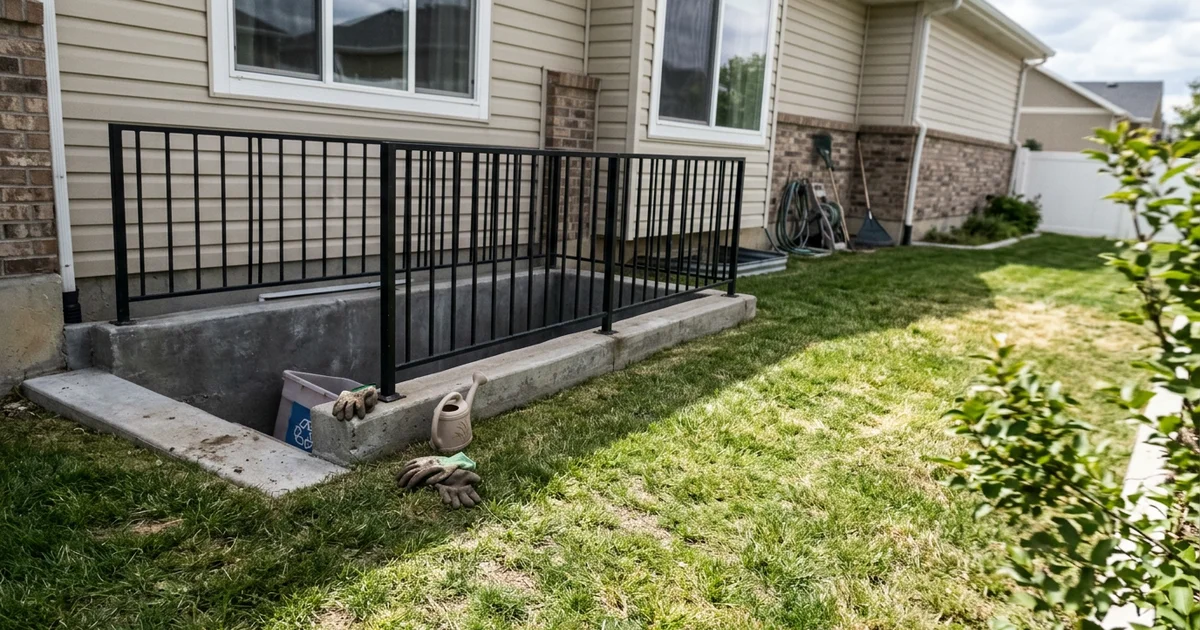
The Cheapest Water to Manage Is Water That Never Arrives
We know that roughly 14 million US homes face basement flooding every year. From what I have seen, a significant portion of that expensive damage starts right at the walkout doors. Our first step in a walkout drainage repair evaluation is always checking the walkout yard slope.
The average 2026 flood cleanup runs $10,000 to $25,000, so finding a way to stop water entering walkout drains is a massive cost saving. Every walkout drain has to handle the direct rain and snow that land in the stairwell. What it should not have to handle is runoff from the entire yard funneling sediment straight down the steps.
This guide will break down exactly what effective grading around a basement walkout looks like based on the latest standards.
Let us look at the code requirements, explore practical adjustments, and detail how to protect your basement.
What Good Grading Looks Like
Creating positive grading around a basement walkout is a fundamental building standard. The 2021 International Residential Code (IRC) Section R401.3 explicitly requires a minimum fall of 6 inches within the first 10 feet away from a foundation.
Our goal is to hit that 5 percent slope so surface water drains outward. Impervious surfaces like concrete patios require a separate 2 percent minimum slope away from the stairwell.
Here is what a properly graded walkout area includes:
- Ground slopes away: Soil falls 6 inches over 10 feet in every direction.
- A raised edge or curb: Surface water cannot spill over the top.
- Beds and mulch: Landscaping sits back from the edge and stays anchored.
- Downspouts discharge away: Water flows far from the walkout.
- Hardscape drains away: Patios slope at a 2 percent grade outward.
Erosion: Grading’s Hidden Cost
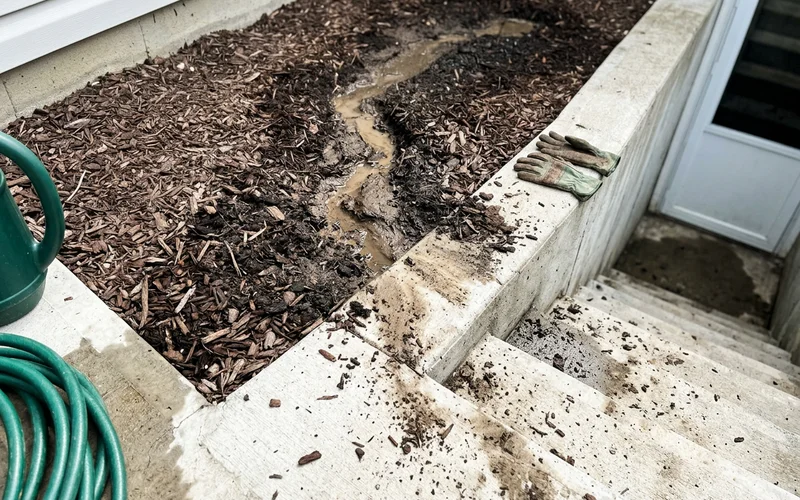
When a bare slope drains toward the walkout, it does not just send water. It sends soil, mulch, and bark down the steps every time it rains.
Our crews constantly pull thick mud out of clogged pipes. That sediment fills drains rapidly, and it is a leading reason why basement walkout drains fail. Fixing negative grading stops roughly 30 percent of wet basement complaints permanently. A simple fix involves installing heavy-duty steel or composite edging to lock mulch in place, preventing thousands of dollars in water damage.
The Stair-Top Curb
A stair-top curb is a raised concrete edge poured around the top of the stairwell. It serves as a simple and highly effective barrier against yard runoff. Our concrete teams typically pour these curbs using a 4000 PSI concrete mix.
This high-strength rating is crucial for exterior applications, allowing the curb to survive heavy freeze-thaw cycles without cracking. Surface water flows around a 4-inch tall curb instead of washing over the edge. On many retrofits, adding this barrier and regrading the surrounding soil does more good than anything else you can do in the stairwell.
Downspouts and Roof Water
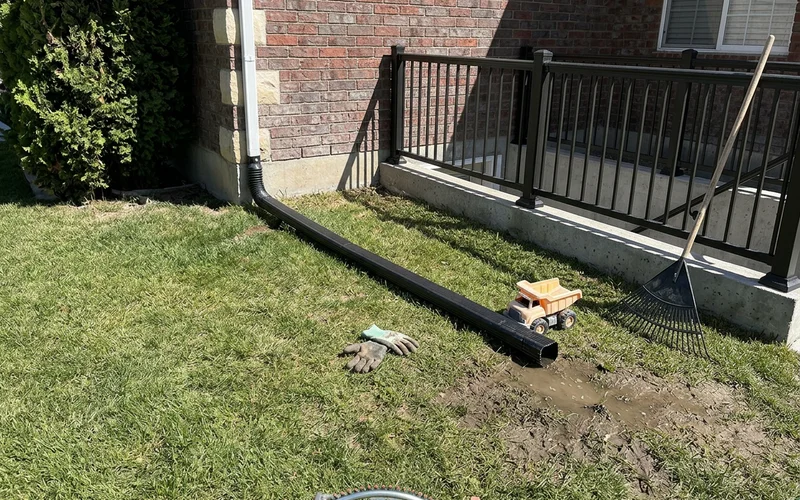
A downspout near a walkout can easily dump an entire section of roof runoff straight onto the stairwell. A 1,000-square-foot roof plane sheds roughly 620 gallons of water during a single 1-inch rainstorm.
Our installers strongly recommend pushing that water as far away as possible. The standard accepted minimum for a downspout extension is 4 to 6 feet. For homes with basements or dense clay soil, the U.S. Department of Energy guidelines prefer an 8 to 10-foot extension. Extending or rerouting the pipe is a quick, highly valuable fix that breaks the concentration of water near your foundation.
| Inflow source | Verifiable Fix |
|---|---|
| Yard slopes toward walkout | Regrade 6 inches over 10 feet |
| Water spills over the top edge | Pour a 4000 PSI stair-top curb |
| Mulch and soil washing in | Install steel landscape edging |
| Downspout nearby | Extend discharge 8 to 10 feet |
| Patio drains toward stairwell | Adjust hardscape to a 2% slope |
Grading reduces inflow. Capacity handles the rest.
Even perfect grading cannot stop rain and snow from landing directly in the stairwell. You still need a drain with high capacity and clear access.
Regrading as Part of Drainage Repair
When our company retrofits a walkout drainage system, regrading almost always goes with it. The process focuses entirely on reshaping the specific soil area that drains directly into the walkout. General yard grading is not something we offer as a standalone service.
Rebuilding the curb and compacting the topsoil prevents the ground from settling later. Handling this exterior surface water first is a smart financial move. Addressing surface drainage often prevents the need for full exterior waterproofing, which easily exceeds $10,000 in 2026.
Grading on New Walkouts
On new builds, the grading plan is designed simultaneously with the walkout itself. A walkout basement typically adds $30,000 to $80,000 over a standard foundation, so protecting that investment with proper drainage is critical.
Our engineering approach ensures the backfill and finish grading actively slope water away from the stairwell. Sometimes this includes cutting a swale, which is a shallow, vegetated ditch that safely redirects hillside runoff around the foundation. Proper compaction and optional landscape restoration finish the yard perfectly. It is a core part of the redundancy behind how our drainage system works.
Simple Grading Checks You Can Do
Catching poor drainage early keeps a clean water issue from turning into a severe mold problem. You can perform a few basic visual inspections to see if your grading is failing.
Our team recommends checking these specific areas during your next heavy rainstorm:
- Watch the flow: Stand outside in a steady downpour and observe exactly where the surface water travels.
- Look for mulch trails: Soil or bark sitting on the stairs proves that active erosion is entering the drain.
- Check the downspouts: Ensure every pipe discharges at least 5 feet out onto an outward-sloping surface.
- Inspect the top edge: Verify that a raised concrete curb blocks the lawn from running straight to the drop.
- Measure patio slope: Place a 4-foot carpenter’s level on your hardscape to confirm it tilts away from the house.
Landscaping Near a Walkout
Planting beds right at the top of a stairwell look attractive, but they act as major sediment sources. Pulling those beds back creates a necessary buffer zone.
Our landscape guidance suggests a few specific upgrades to protect the drain:
- Install commercial-grade edging: Heavy steel or composite borders hold mulch firmly in place during heavy rain.
- Choose deep-rooted native plants: These stabilize the soil far better than shallow, seasonal annuals.
- Switch to drip irrigation: You must absolutely avoid using traditional sprinkler heads that spray toward the stairwell.
Grading and Snow Storage
In the winter, where you pile your cleared snow quickly becomes a serious grading question. Ten inches of piled snow melts down to roughly one inch of standing water.
Our maintenance advice is to never pile snow directly at the top of the stairwell. That snow will melt straight into the walkout, and the resulting freeze-thaw cycle can crack your concrete walls. Plan a designated snow storage spot that clearly drains away from the basement. Keep the area immediately around the top edge completely clear when you shovel.
Water Pouring Into Your Walkout?
Surface water pooling against your foundation is a problem you can permanently solve. If water is actively overwhelming your stairwell, it is time to check the slope.
Request a drainage evaluation and we will investigate exactly where your water is originating. We can implement the correct grading around a basement walkout to keep your lower level completely dry.